ASSORTED SHORT STORIES AND POEMS
THE THRILL OF A LIFETIME
After his 60th birthday, Robbie started telling people to call him "Rob" and began thinking of himself as old. He lived alone and his parents were dead. Looking backward instead of forward, he faced the facts of his life: he would never go to college; he would never travel to Australia; he would never be part of a rock band; he was never going to be a father, and now that his second wife had left him he would never marry again. He would never quit smoking; and he would never be back to his high school weight until he was sick and dying. Someday he would be buried in the same boring town where he was born. The black grime under his fingernails was never going away because he was going to run the Exxon station until he dropped.
Of all the nevers he had to face, the hardest to think about was this: he would never see Wendy again. Wendy came to mind on this particular day, as he packed up his apartment so he could move to a smaller one because his rent had doubled and his income had not. He packed his collection of LP's and when he came across his high school yearbook he went to the page where Wendy smiled at him with pearly white lipstick. Wow. The sepia colored Loring photo obscured the color of her hair that she complained about but had driven him crazy with yearning to touch. Her smile reminded him how much he had liked her naively upbeat view of the world at a time when he mocked everything as dark and pointless. He stared for a moment at the photo, then snapped the yearbook shut and dropped it in a box.
She was the one who got away. But now he was sure they never had a chance. She was a lawyer’s daughter, an only child in a family with a country club membership. An honor student who played cymbals in the school marching band. A girl filled with optimism, school spirit and lots of friends. He was a kid who grew up with four younger siblings he had to look after because there was no dad and Mom worked two minimum wage jobs. Robbie was a rebel, a cutter of classes and the most successful seller of marijuana in the school. Wendy wore penny loafers shiny as her auburn hair. He wore stained tee-shirts and faded jeans from the Goodwill store. She was a passionate fan of the Beatles; he thought they were overrated and preferred Grand Funk Railroad. A golden "Wendy" necklace decorated her throat; a hard pack of Marlboros left its outline on his back pocket.
Wendy was obsessed with NASA and the space program. Robbie ‘s ambitions topped out at playing guitar in a band and buying a pickup truck. He mocked her ponytail and her clothes and her family. He offered her joints of good Columbian and tabs of acid, but she always said no, thank you. He dreamed about changing her, taking her cross country with him in his truck and living in L.A. He ignored the fact that she was accepted to MIT and he was probably not going to get his diploma. Still, they continued an odd friendship. They joked around in class, spent hours on the phone. They never became a couple, even though others in school thought they were. Robbie never let on to her that he thought she was perfect; that he couldn't believe or understand why she talked to him at all. Maybe it was because he was witty and made her laugh. And back then he looked sort of like James Taylor. (Well, if James Taylor was heavier and not so tall. And wore glasses.)
Life hadn't treated him well. Not at all. So many nevers. Maybe if he and Wendy had got together things might have been different. But 1969 got in the way. Wendy's biggest thrill was the Apollo 11 moon landing, Robbie's was scoring two $18 tickets to Woodstock in a drug deal.
Those Woodstock tickets were set in a frame and hung on the wall. He took it down and stared at it. Maybe they were worth something now.
When he got them, he called Wendy.
"I've got tickets to this outdoor concert next week in upstate New York." He told her. "Let's go." They would hitchhike. Camp in the woods. It would be a blast. What an adventure!
"My parents would never let me." She said, "Besides, why would I want to do that?"
This pissed him off. They were on different planets. She would never be his hippie chick. He wouldn't be able to change her. He hit back, told her she should tell her parents to go fuck themselves.
“Do something real for a change! Break some rules, baby!”
“I’m leaving in two week for school.”
“You’re never going to be an astronaut.”
“Thanks.”
“You are such a fool.”
She hung up on him.
He threw those Woodstock tickets in a drawer . He saw the news coverage on television. The stopped traffic on the New York Thruway. Rain, mud, debris, portajohns. Sex, drugs and rock ‘n’ roll looked like a weird kind of fun. He was secretly glad he wasn't there.
Wendy left town and they never spoke again.
When the Woodstock movie came out a few months later, everyone went to see it. Everyone talked about it. Robbie started telling people he'd been there, and showed his tickets to prove it. He said he tripped with John Sebastian and bathed naked in a river a girl with a hair to her waist. His friends treated him like a hero; people asked him about it all the time, just as they asked returning soldiers what it was like in ‘Nam.
Woodstock became his thrill of a lifetime. He told the stories so often he almost believed he had truly been there.
In 2015 he found Wendy on Facebook. She was a grandmother. Her hair was still red – had to be from a dye-job. She was some kind of office clerk at the Johnson Space Center in Houston. She posted a picture of the thrill of her life: when she shook Neil Armstrong's hand at an Apollo 11 anniversary event. Rob shook his head and lit a cigarette. Hadn’t he tried to tell her in 1969 she’d never become an astronaut? He considered sending her a private message on Facebook. He thought better of it.
He tossed his framed Woodstock tickets into a box along with his collection of baseball cards and Penthouse magazines and his Colt-45 beer mug. His Schwarzenegger and Stallone DVDs went into a nearby trash can.
Suddenly he got choked up. All those nevers.
Wendy. What could have been. Should he have tried harder to keep her? Maybe.
But one thing he was sure of:
He damn well should have gone to Woodstock. Maybe then everything would have been different.
THE END
2020
HAIKU: Crowning Glory
Let go. Let it grow.
Time to let everyone know.
Its color is: Snow.
*******
At a writers worshop, 2015:
ANASTASIA
Brendan’s rescue pup
His dog.
Our dog.
His again.
Ours again.
Old now.
Gold now.
White of face.
Special place
In the hearts of all.
She still loves to chase a ball.
When she leaves us
She will go
Find her boy with the halo
Answering Brendan’s call
And in heaven chase a ball.
*******
2019
THE TALKER
His plane departed Orlando International Airport for his hometown of Boston more than an hour late. As a result, when George Marks, the motivational speaker, arrived at Logan Airport, he was forced to hustle through the terminal, jump into a taxi and push the driver to rocket him straight to the conference center, as he furiously texted that he was on his way for his scheduled appearance there.
It was a packed house that anxiously awaited him at this highly-promoted event. Having paid twenty-five dollars apiece to sit in an under-air-conditioned auditorium, the audience was a mélange of all sizes and shapes, all ages and stages of life, hungry for the knowledge of the new concept Marks would unveil that promised to change their lives. This Boston appearance was the kickoff in a six-city tour that would change George's life too.
As he exited the cab and ran up the steps into the building, adrenaline pumping through his body signaled his performance readiness, despite his annoyance at being late. This was the big break, what he had been working toward for years. It would mean selling thousands of copies of his new book "Messages from the Heart: How to Figure Out What You Want and GO GET IT!". Maybe millions of copies. It wouldn't be like the first one, ending up on all those discount bookstore clearance shelves and leaving him without an agent. The most important thing this would mean was that Kristina would finally see that she could believe in him; he was not a snake oil salesman. He would be able to buy that 40-foot boat he'd promised her and they would sail all around the world, like she wanted. Now, after four years together, she would finally agree to marry him. He imagined the renewed love and admiration in her eyes, her smile of approval, future children with her dark curls and long dark lashes.
There was no time for his customary offstage preparatory breathing and stretching exercises; he ran straight out to the podium, shaking hands with the host, who had worked up a flop sweat filling the time onstage while they waited for George's arrival. The host scurried away, leaving the stage to George alone, who smiled broadly and stretched out his arms, Christ-like, embracing the bright lights and a theater full of captivated, smiling faces. After a quick and jokey apology about his lateness, he launched into his always-successful icebreaker story about the rhinoceros and the penguin. And then his eyes fell on the single empty seat in the front row.
At Logan Airport, Kristina moved through the crawling security line, a tight grip on her passport and boarding pass. She looked at her watch and thought about George. He would be done with his speech now. She wondered if he noticed she wasn't there. Probably not. George tended to miss important details.
Little things, like who she was.
She had grown up with one dream: to travel to South America, to touch the land of her ancestors. To see the small Colombian town where she had been born and the orphanage from which she had been adopted. To eat unfamiliar dishes in Brazil. Party in Rio de Janeiro. Hike in the Andes. Go to the bottom of the world. Visit Macchu Picchu. All her life she had known she would have to do this someday, and her parents had never discouraged her. The contrast between their pale hair and freckles and her flawless bronze skin and thick, dark hair had been a daily reminder that she came from somewhere else, a place that called for her return.
George was always talking about a boat. She didn't like boats. She told him she needed to visit South America at ground level, to walk it, feel it, be with her people. Why did he think she had been taking those Rosetta Stone Spanish and Portugese lessons for a year? Last week she told him she was going to buy a plane ticket.
He kept talking about their future together. The new book. The tour.
On stage, George was on autopilot; he'd practiced this presentation a hundred times. He had this. Why was it so hard now? He talked, but with each word he increasingly felt he couldn't catch his breath, as if he were still running. He was gulping air. Damn airline! Totally got me off my game! Damn!
The empty seat in the front row mocked him. He lost track of his thoughts; lost his place in the monologue, broke into a cold sweat. He took off his jacket, rolled up his sleeves, loosened his tie. Talking. Talking. Talking. This is what he was good at. He could make it look effortless, usually. This time he was talking, but thinking, "Shit, this is not going well….."
The faces in the crowd began losing their smiles. Some leaned close and whispered.
His mouth kept moving, but he was dying.
He stopped, looking at the floor of the stage, trying to regain his mojo. Gone.
"I - I'm sorry. I'm not feeling well…." He turned and stumbled off the stage, collapsing to the floor as soon as he was out of the lights. Members of the stage crew rushed to his side. Someone said, "Call 911!". Someone said "heart attack." Someone else said "stroke". Before he passed out he heard another voice say, "panic attack."
A little while later, after the ambulance left, the host came out to the podium, mopped his brow and explained that their honored guest Mr. Marks was going to be okay, but due to an unexpected health emergency, his appearance would have to be canceled. He apologized and dismissed the audience, promising refunds. As the audience mumbled and grumbled and filed out of the giant hall, several took one last dismayed look at the stage; at the massive, brightly colored Power Point backdrop: a photograph of a smiling George Marks, with the tag line, GEORGE HAS THE ANSWER! ALL YOU HAVE TO DO IS LISTEN!"
THE END
*******
(Abridged version)
HE LAUGHED AT THE UNIVERSE
He was irreverent; too wise for a world of
Illogic and serendipity and irony.
Nothing was sacred or immune from mockery.
Himself included.
You had to laugh.
In Paris, he wore a black beret.
At the Louvre, in a hall of priceless antiquities
Climbing upon a pedestal
Behind a headless nude
Laid his chin and bereted head
And now the statue had a smile.
We took a photo and laughed.
A docent came running, shouting in French.
We had to leave.
Dark humor expressed in his drawings.
A cartoon queue of happy stick people
Climbing a hill to a banner: “You Can Fly!”
Not seeing the cliff on the other side.
Falling, falling, falling…..
Landing in a heap; bewildered, betrayed.
He made us laugh; some said he was troubled.
It was only that he laughed at the absurdity
Of the universe.
“No Trespassing” signs should be ignored.
Fences should be climbed.
No rule should go unbroken.
Under his beret he thought that statues don’t mind.
And there are many ways to fly.
Then, age 30, a sudden, random, ironic ending
(He would say a Darwin award winner)
Falling like his stick people while he was dreaming of other things.
Somewhere, he is laughing at the absurdity.
------------------------------------------------------------------
THE FERRY
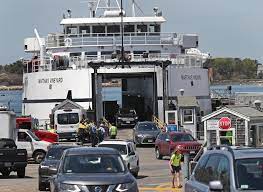
She doesn’t swim. Never liked boats. Especially if they tip or rock. She only boards this one, the Martha’s Vineyard ferry, one round trip each July for a few days visit, because Dan spent his childhood summers here and he needs it. But she can only step on the gangway if it is a sunny day, the ocean waters calm. Dan always holds her hand during the entire half-hour crossing. She isn’t afraid when he looks in her eyes; when he says her name. Rachel.
Something isn’t right. Why is she here now on the ferry? And where is Dan? She fights panic. No calming sunshine this trip. Leaden sky. Choppy stone-colored ocean. Icy wind and rain whip her face and frizz her hair. She stands on the top deck, white-knuckle gripping the railing and looking down at the whitecaps.
Crazy thoughts race. Does this captain know what he is doing? How much rocking can this boat stand before it goes under? I used to know where they store the life jackets, but now I can’t remember. Do they have a bathroom on this boat, because I may have to pee? Why are there no voices, no sound but the howling of the wind? The rows of white deck seats stand empty, like gravestones. Where are the summer people? The chilled out J-Crew people who own houses on the island, with their smiles, their toned and sunkissed arms and legs, their so fashionably sun lightened hair. A charming Ralph Lauren scene in a glossy magazine, they tease and laugh with their gleeful children, push their doe-eyed toddlers in $700 state-of-the-art strollers. They pat their well-behaved shiny black dogs that curl up on the deck at their feet. Wide-brimmed straw hats and Red Sox caps. These lucky people are free to wear linen, because someone else does their ironing. Rachel hates that she needs them on this ferry because they guarantee that she is safe; nothing bad could ever happen to these people. But they are not on this trip. Where have they all gone? And where is Dan? How did I get here without him? Why am I alone on this fucking boat? He will pay for this.
Suddenly, her thoughts clear. It's the dream again. The wind and rain and rocking boat are not real. Her hands relax, ungrip the cold metal railing. She steps back from the side and closes her eyes. Safety is within reach. All she has to do is awaken, and everything will be okay. Except. It won’t.
Reality is as sharp and cold as the wind in her dream. Before her eyes open she remembers that Dan’s side of the bed is empty. She will not smell fresh brewing coffee and will not hear him rattling around the kitchen. The pain and dread will be real. She will remember and ache for the halcyon days of good food and wine and music and sex, when rainy days seemed bright and sunny days seemed endless. When they would laugh easily, and waste money and time because they thought it would always be that way. She will ache for the salty wind in her hair and Dan smiling into her eyes and holding her hand on all those happy summer ferry rides to the island that assured her they were just like the J-Crew people; they were safe from harm.
People say time heals. Can she wait that long? When will the memories of Dan no longer pour all over her brain like syrup, haunting her nights? What will it take? Must she take the Martha’s Vineyard ferry back and forth and back and forth to the island until the longing and sorrow fade?
As her bare feet touch the cold floor she promises herself she will do just that.
THE END